
The Unmeasured Layer in Digital Transformation: Leadership
Digital maturity reports promise to show where an organisation is falling behind. Which dimensions those reports actually measure — and which they never touch — is rarely on the reader's mind. Systematic reviews published in recent years have answered that question by counting models one by one, and a consistent asymmetry emerged: the layer everyone agrees matters most to the success of a transformation is among the least measured. This article sets out that gap with its primary sources and ends with five concrete questions for the next assessment.
The Part Everyone Agrees On: Transformation Breaks at the Human Layer
Start with what is not in dispute. That digital transformation breaks not on technology but on people and leadership is by now a finding backed by broad data.
In McKinsey's global survey of more than 1,700 participants (2018), only 16% of digital transformations both improved performance and equipped the organisation to sustain the gains. The success characteristics that same research identified fall into five categories: leadership, capability building, empowering workers, upgrading tools, communication. Four of the five are about people; only one is about technology.
In Prosci's benchmarking research, running since 1998, the number-one contributor to change success comes out the same in every cycle: active and visible executive sponsorship — cited four times more often than any other factor. The less-discussed finding from the same research: 58% of sponsors do not have a strong understanding of their own role in leading change effectively. The most critical factor is also the least understood role. The cost of that gap has been measured too: projects with extremely ineffective sponsors were 27% likely to meet their objectives, against 79% with extremely effective ones.
BCG's resource-allocation principle, drawn from consulting practice, points the same way: 10% of transformation effort to algorithms, 20% to technology and data, 70% to people and process. This is not a measurement but a principle — and should be labelled as such.
Which Dimensions Do Maturity Models Measure?
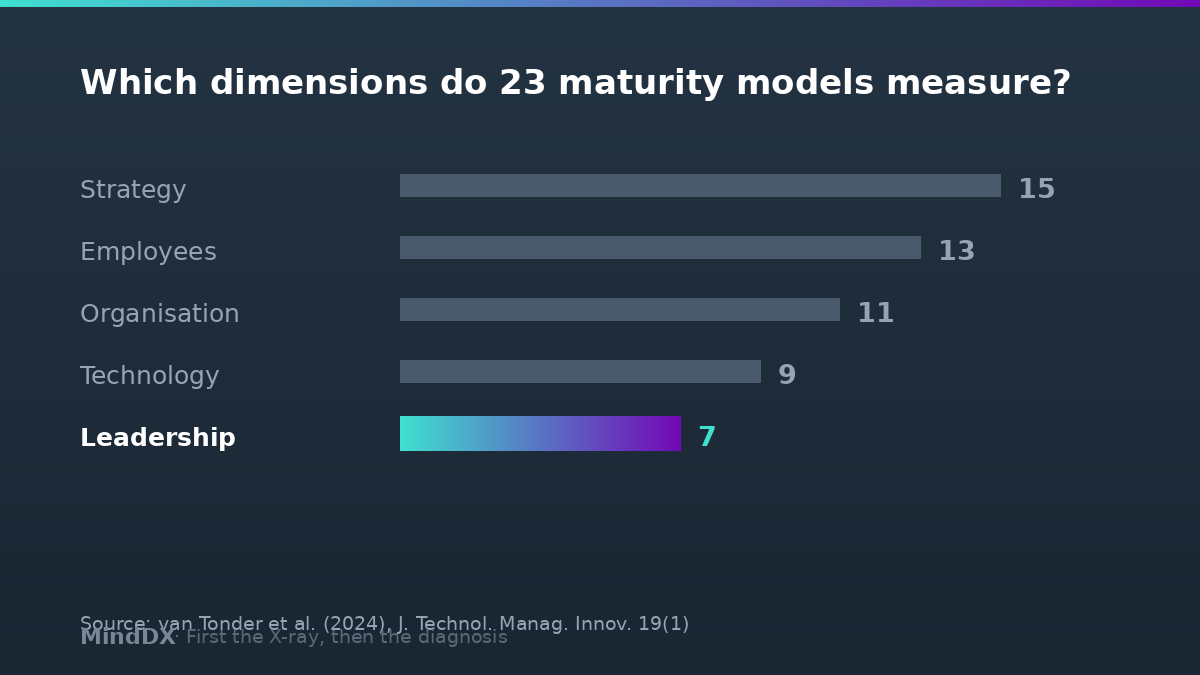
So far, so agreed. The real question: is the layer we know to be decisive actually being measured?
A systematic review published in 2024 (van Tonder et al., Journal of Technology Management & Innovation) surveyed the digital maturity models used with SMEs: it drew 23 distinct models from 29 studies and marked, one by one, which dimensions each model measures. The table:
| Dimension | Measured in how many of 23 models |
|---|---|
| Strategy | 15 |
| People / employees | 13 |
| Organisation | 11 |
| Technology | 9 |
| Culture | 8 |
| Customers | 8 |
| Leadership | 7 |
| Processes | 6 |
| Products | 6 |
The subtle point in this table matters more than it first appears. It is not that the field ignores people: the "employee" dimension is measured more often than technology. What goes unmeasured is the management layer of the human side. And the same review notes that some researchers argue strategy and leadership should count as a single dimension — meaning that even where leadership does appear, it is often folded into strategy and left without a reading of its own.
In a review that examined general and domain-specific maturity models separately (Teichert, 2019), the area most addressed by domain-specific models — manufacturing among them — is technology; leadership sits at the very bottom of the list alongside vision, appearing only once. In fairness, the same study also reports the reverse: in general models the picture inverts — there the most addressed area is digital culture, with technology second. So the gap is not across maturity measurement as a whole; it deepens as models descend into a sector, precisely where implementation happens.
Another review published this year (Stef et al., 2026) surveyed 60 studies. Most models assess operational, organisational and strategic elements together; but the number of models that make the strategy of transformation a distinct object of assessment alongside its outcomes and process is just three out of 60.
Reduced to a sentence: the layer we agree matters most is the layer we measure least. Put more precisely — leadership is not unmeasured; it is unmeasured on its own terms.
Why Isn't Leadership Measured? Three Honest Reasons
1. It's hard
Counting servers, modules and data infrastructure is easy: auditable, billable, tabulated. Leadership rests on self-assessment, is open to perception, and is sensitive. Measuring what is easy to measure has always been more tempting than measuring what matters.
2. It's uncomfortable
A low technology score is a case for investment; nobody takes offence. A low leadership score points at the person who commissioned the report. From the vendor's side, selling a report that tells the client "the missing piece is you" is hard.
3. The "it can't be measured" assumption
The weakest of the three, because it isn't true. The instruments used for transformational leadership have been tested in thousands of academic studies; validated scales developed for digital leadership exist — one has been adapted into Turkish and validated on a Turkish sample. Measurement is possible; it simply hasn't been integrated into maturity assessments.
One more note on honesty: measuring leadership is not an objective reading in the way measuring technology is — it rests on perception and should be presented that way. But the problem is not the flaw itself, it is the undeclared flaw. A leadership measurement that openly states it is perception-based, draws on many respondents and publishes its method beats not measuring at all.
An X-Ray Shows Bone, Not the Heart
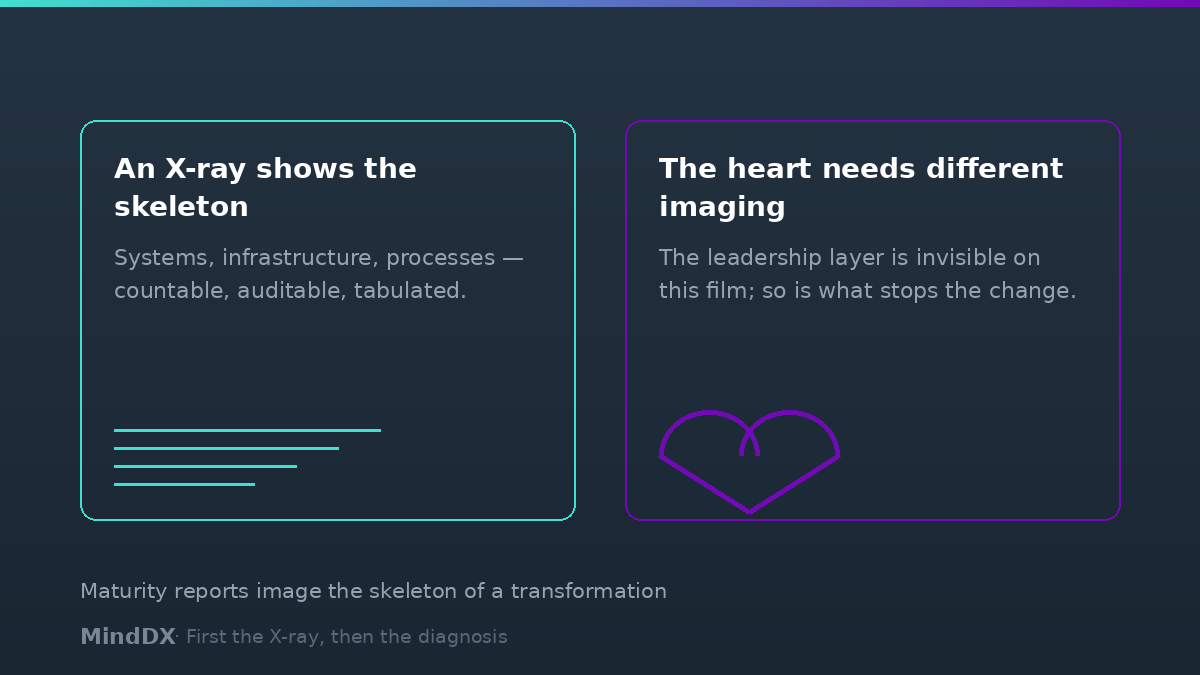
An X-ray shows bone perfectly. But if you need to see the heart, an X-ray won't do; a different kind of imaging is required. The problem is not the device — it is trying to image the wrong organ with it.
Most maturity reports today image the skeleton of a transformation: systems, infrastructure, processes. The skeleton matters. But like the three root causes discussed in an earlier article, what actually stops a transformation does not appear on that film. The diagnosis-first principle goes one step further here: taking the right film is a precondition for reading it right.
Five Questions That Probe the Leadership Layer
At the next maturity assessment — or today, inside the organisation — these five questions quickly reveal whether the leadership layer is being measured:
- Who owns this transformation? If the answer is "IT" or "the project team", the most critical success factor has been delegated from the outset. Ownership is not a line item you can hand off.
- Can the executive team describe what the sponsorship role requires? Signing is not sponsorship. Sponsorship means being visible, defending resources, and stepping forward when resistance appears. A role that cannot be described cannot be performed.
- What does middle management gain from this transformation? The "frozen middle" — nodding in the meeting, changing nothing on the ground — is the quiet stopper of transformations. Where the gain is undefined, resistance is rational.
- When did the leadership team last assess its own digital capability? A management team that does not do the learning it asks of its people is running the transformation through rhetoric rather than practice.
- Does your maturity report have a leadership dimension — and how was it measured? If not, the report is showing you the skeleton. If yes, the next question is method: how many respondents, which scale, and was its perception-based nature declared?
Conclusion
The real gap in maturity measurement is not a missing dimension but a blind spot: the most decisive layer is the same one that is most uncomfortable to measure. That gap is not a technical constraint — the instruments exist. Closing it requires only a willingness to publish a score that might come out low.
This article is the fifth part of the expanding «From Man-Days to Value» series.
1. Is the End of Man-Day Consulting Near?
2. Let's X-Ray the AI Promises
3. What Did AI Make Cheap in ERP, and What Did It Make Valuable?
4. Diagnosis-First ERP: What Does the New Path Look Like in Practice?
5. The Unmeasured Layer in Digital Transformation: Leadership
6. (coming soon)
To keep up with new analyses, subscribe to the MindDX-Digital Excellence newsletter.