
What Did AI Make Cheap in ERP — and What Did It Make Valuable?
Claims like "AI cuts ERP costs by X percent" say little on their own; the percentages vary from company to company and project to project. What matters is not the percentage but the mechanism: which parts of an ERP project does AI make cheaper — and which does it make more valuable? This article walks through that question stage by stage.
The Hidden Effort Map of a Classic ERP Project
In a traditional ERP project the big effort items are well known: testing, data migration and mapping, documentation, training, customization code. What they share is that they are mechanical work performed after the decisions have been made. Discovery and analysis get a small slice — and that smallness is an economic choice, not a technical one: in the man-day model, discovery is the hardest phase to bill. The customer feels "nothing has been built yet"; the vendor wants to move on to billable implementation.
The result is a familiar picture: the most critical decisions — scope, process design, the customization boundary — are made in the weeks when the least is known. The value curve follows: value produced during the long build months is close to zero, and everything piles up in the steep rise at go-live. The industry's name for that curve is the "hockey stick".
What AI Actually Does: It Redraws the Effort Map
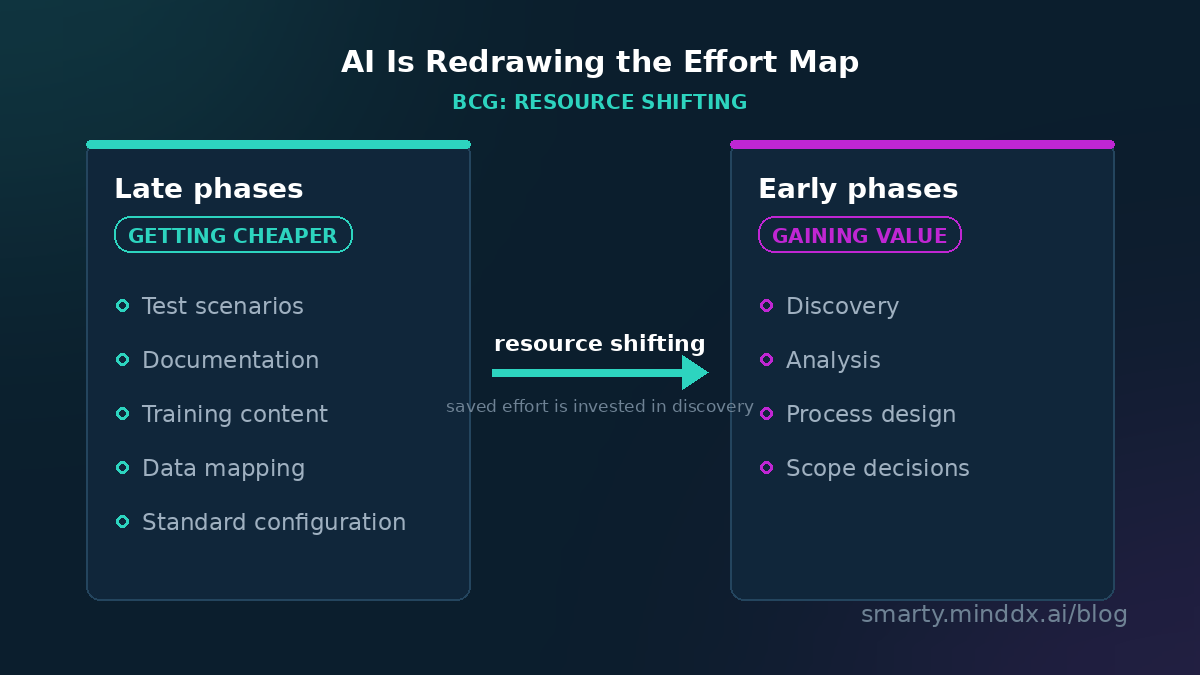
According to BCG's analysis of generative AI in ERP transformations, the biggest savings estimates cluster in the same region: testing (an estimated 60–70% time saving), training and documentation production, data cleansing and mapping, and standard configuration. McKinsey's ERP research makes an even bolder prediction: AI agents could reduce ERP implementation effort by at least half. Both figures are forecasts, not measured industry averages — but the mechanism they point to is solid: repeatable, rule-based, high-volume work is the work most suited to automation; and the late phases of an ERP project are largely exactly that.
Stage by stage, the picture looks like this:
| Stage | AI effect | What is happening? |
|---|---|---|
| Test scenarios | Getting cheaper | Generation and execution largely automated |
| Documentation and training content | Getting cheaper | Content production is automated |
| Data cleansing and mapping | Getting cheaper | Mapping suggestions automatic, approval stays human |
| Standard configuration | Getting cheaper | Fast template-based setup |
| Discovery and process analysis | Gaining value | Becomes the stage that determines decision quality |
| Scope and design decisions | Gaining value | Can now be made with the most information |
| Human approval / oversight | Gaining value | The safety condition of automation |
In X-ray terms: the machine got cheap — taking the image is now fast and inexpensive. But once everyone can take the image, reading it correctly becomes the real differentiating skill.
The "Hockey Stick" Is Flattening: Resource Shifting
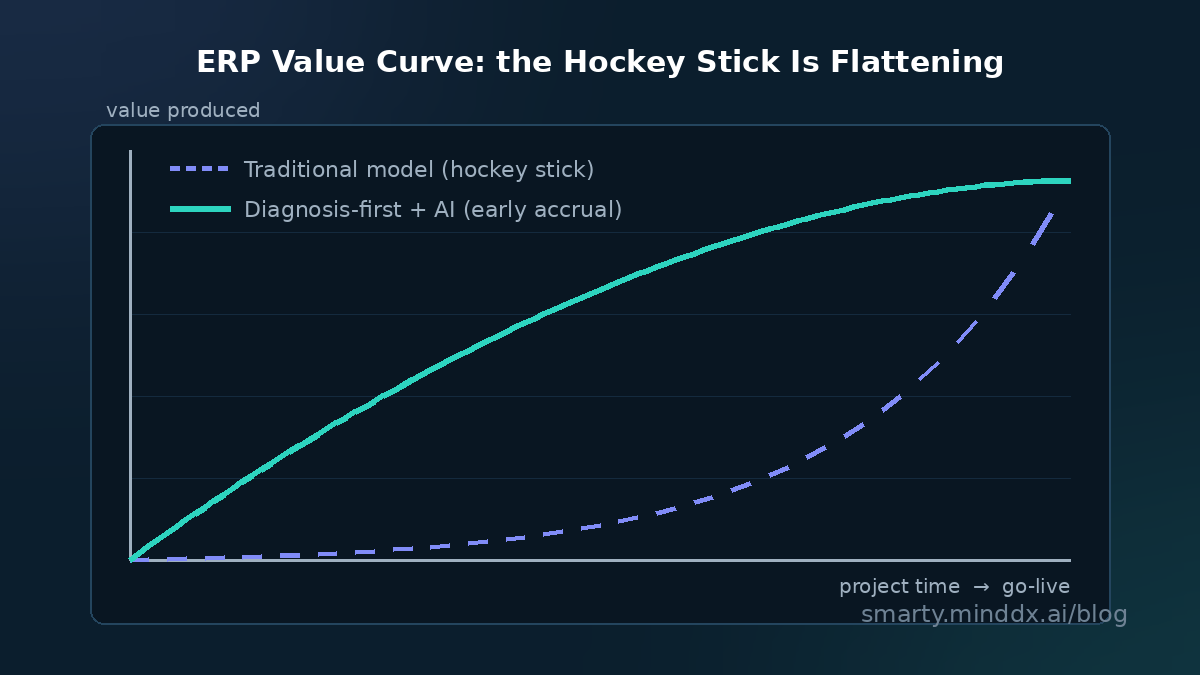
BCG's name for this dynamic sums up the mechanism: resource shifting. Effort saved in the late phases does not disappear; it moves to the early ones. Discovery stops being the "hard-to-bill formality" and can be repriced as the highest-return investment in the project — because every hour invested in discovery now determines the quality of all the cheapened mechanical phases. And value stops exploding at go-live; it starts accumulating from the first weeks. The hockey stick flattens.
There is also a measured example: in the Deloitte–UiPath SAP S/4HANA migration, more than 200 automations went live across core processes, more than half of the test cases ran automatically, and a 93% "clean core" was achieved. A single case, vendor-sourced — not enough to generalize; but a signal of the direction.
The Mechanism's Operating Condition: Measure First, Then Automate
The mechanism has a hidden precondition: automation inherits the quality of the ground it is built on. The three root causes from the second article in this series return exactly here: test automation on dirty data tests the wrong thing faster; standard configuration on unmeasured processes builds the chaos faster; unaudited automation scales the error. The savings of the cheapened phases only materialize if discovery and diagnosis were done right. In the new model, the money flows to the stage that used to be considered "free" — the diagnosis.
The 5 Rules of the New Economics
- Mechanical work gets cheaper: testing, documentation, training content, data mapping — stop paying full man-day rates for these items.
- Diagnosis gains value: discovery is no longer a formality; it is the highest-return investment in the project.
- Sequence is everything: measure first, then automate; the reverse accelerates chaos.
- Early decision = cheap decision: scope and design decisions should be pulled to the moment of maximum information.
- Human approval is not negotiable: faster analysis does not decide; the physician who reads the film must stay in the model.
Conclusion: The Right Question Has Changed
The question from the first article in this series — "is your consultant selling hours or outcomes?" — has become concrete with this mechanism. The new question at the proposal table is: "How much of my money goes to mechanical work, and how much to diagnosis?" If the rate for mechanical work is falling while the value of diagnosis is rising, the weight of the budget should shift the same way. The final article in the series will look at what this approach means in practice: how a diagnosis-first ERP journey proceeds, step by step.
This is the third article of a 4-part series.
1. Is the
End of Man-Day Consulting Near?
2. An X-Ray of AI
Promises
3. What AI Made Cheap in ERP, and What It Made Valuable (this article)
4. Diagnosis-First ERP: What
Does the New Way Look Like in Practice?
In the final article of the series, a free tool was shared that lets you see your own ERP risk in 10 questions: Diagnosis-First ERP: What Does the New Way Look Like in Practice? To not miss new analyses, subscribe to the MindDX-Digital Excellence newsletter.