
Let's X-Ray the AI Promises
The strongest narrative of the last two years in the ERP world is clear: artificial intelligence will finally fix the failure rates that haven't moved in decades. Sales decks, product launches and industry events repeat the promise daily. Yet the data published by research firms points to a different picture: a significant share of AI-powered ERP projects will fail too. This is not an anti-technology piece; on the contrary, it is an attempt to separate a genuinely powerful technology from the hype. Because the problem examined in the first article of this series — committing without measuring — doesn't disappear under an AI label; it just gets new packaging.
Why Are the Numbers So Quiet?
The louder the marketing, the quieter the research data. Gartner predicts that more than 40% of agentic AI projects will be canceled by the end of 2027, citing escalating costs, unclear business value and inadequate risk controls. The same firm's ERP-specific forecast is starker: according to the "Predicts 2025: Revisit ERP Strategies" report, fewer than 10% of organizations deploying agentic AI in their ERP will have achieved measurable value by 2027.
The pilot field looks no different. Deloitte's 2025 research shows 38% of organizations piloting AI agents while only about 11% actively run them in production — the picture the industry calls "pilot purgatory": impressive demos, projects that never ship.
An honest note: most of these figures are forecasts and survey findings — measured facts they are not; they are not final results. But all of them pointing the same way should not be dismissed as coincidence: an AI label alone does not change the success rate.
So Why Do They Fail?
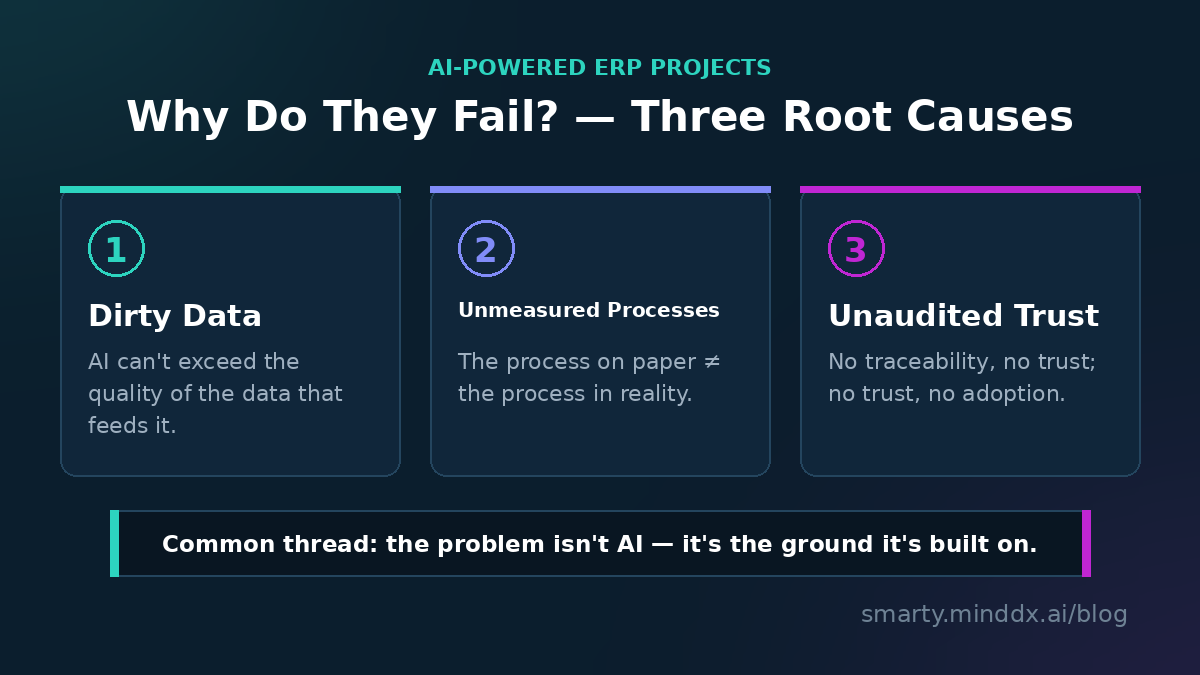
The answer is not that the technology is bad — it's that good technology is built on bad ground. The three root causes behind stumbling AI-powered ERP initiatives form a single, self-reinforcing chain.
1. Intelligence Built on Dirty Data
AI cannot exceed the quality of the data that feeds it. Duplicate customer records, inconsistent stock codes, stale master data — a model built on these doesn't make smarter decisions; it makes wrong decisions faster. In the same ERP report, Gartner projects that 70% of organizations will lack AI-ready ERP data by 2027. IDC research shows the other side of the coin: in the AI era the real differentiator is not algorithms but data readiness and infrastructure — whoever has the cleanest data will pull ahead.
2. Automation Built on Unmeasured Ground
In most organizations, processes are known "as they should be": the flow in the procedure document, the approval chain in the org chart. How the work actually runs — orders taken by phone, approvals circling in Excel, person-dependent exceptions — has usually never been measured. Automation blows up exactly on that gap: an agent built on the paper process doesn't recognize the real one. Automating a broken process doesn't remove the error; it scales it.
3. Unaudited Trust
The third cause is managerial, not technical. Forrester's "trust tax" concept sums it up: every autonomous decision must be loggable and defensible to an auditor — and today that cost is high for most organizations. A decision that can't be traced won't be trusted; without trust there is no adoption. The remedy is human-in-the-loop: where the AI stops and where a human steps in to approve must be a boundary drawn at design time, not a feature bolted on later.
The three causes share one root: the problem is not the AI itself, but the ground it is built on.
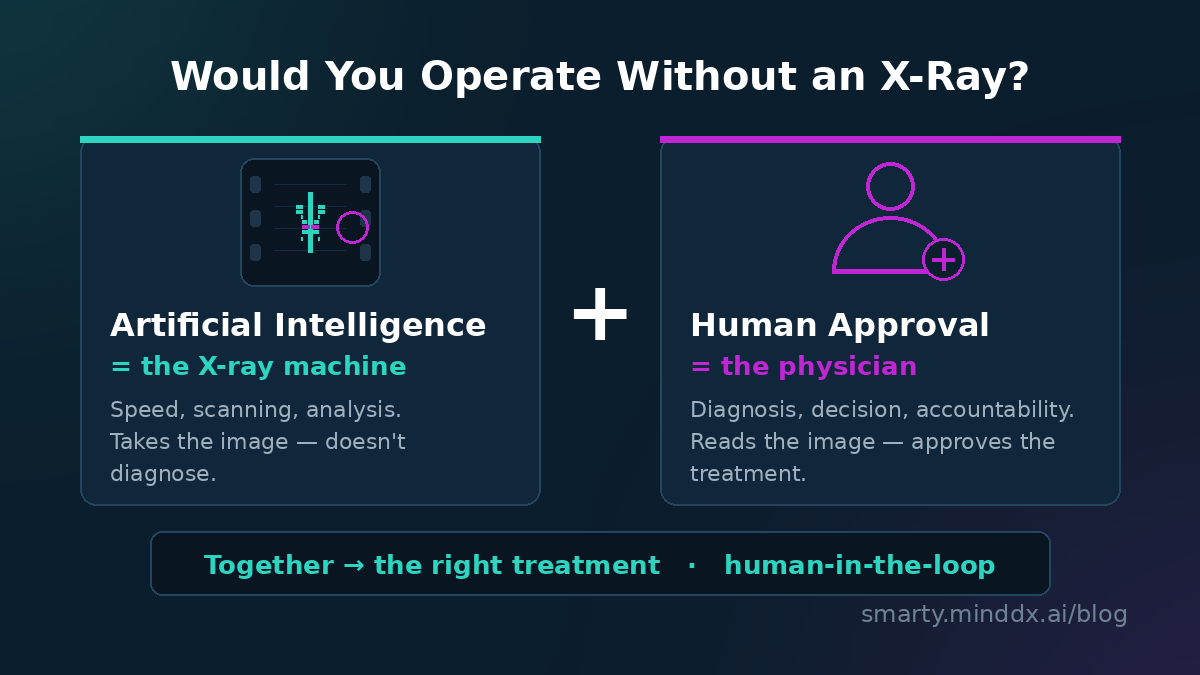
Would You Have Surgery Without an X-Ray?
A proposal made without measuring us is a prescription written without a diagnosis. In this equation AI is a superb X-ray machine: it scans fast, produces sharp images, catches patterns the human eye misses. But an X-ray machine cures no one on its own — you need the physician who reads the image, makes the diagnosis and approves the treatment. A good share of today's AI-powered promises amount to selling the X-ray machine and firing the physician. The right order hasn't changed: first the X-ray, then the diagnosis, then the treatment — with a human making the call at every step.
4 Questions to Ask a Vendor That Says "We Use AI"
When you hear "AI-powered" at the proposal table, these four questions separate substance from hype. Clear answers signal a serious approach; evasive ones mean the label is just packaging.
- Is our data of the quality this AI needs? If not, how do we fix it first? (An instant "we can start right away" without measuring data quality is an invitation to root cause #1.)
- Do you know our processes as they should be, or as they actually run? Without a current-state measurement, the automation gets built on the paper process.
- Who audits the AI's decisions, and how? Are logging, traceability and the audit mechanism defined from day one?
- Where does the AI stop and the human step in — can you show us? If the human-in-the-loop boundary isn't drawn, you are the one paying the trust tax.
Conclusion: An Accelerator, Not a Savior
AI is not a savior; it is an accelerator: it drives a badly framed project into the wall faster, and makes a well-framed project stronger. What decides the outcome is not the technology but the ground under it — clean data, measured processes, audit by design. The third article in this series looks at the other side of the coin: what AI genuinely changes in ERP projects, and by what mechanism — not in percentages, but in how the work itself runs.
This is the second article of a 4-part series.
1. Is the
End of Man-Day Consulting Near?
2. An X-Ray of AI Promises (this article)
3. What
AI Made Cheap in ERP, and What It Made Valuable
4. Diagnosis-First ERP: What
Does the New Way Look Like in Practice?
To catch the rest of the series and new analyses, subscribe to the MindDX-Digital Excellence newsletter.