
Why Do Digital Transformation Reports Gather Dust?
Picture a routine health check. The bloodwork is back, the imaging is done, the report is in your hands. The physician walked through each finding, and there are a few recommendations at the bottom of the page. Then what happened? For most people the answer is the same: the file went into a drawer and life carried on. The report was not wrong; it simply changed nothing.
In enterprise digital transformation, the most common waste is not the absence of measurement. Measurement happens, a report is produced, a presentation is given — and the report stays on the shelf. The distance between diagnosis and treatment is the quietest loss in transformation projects: nobody makes a mistake, nobody cancels anything, and nothing happens.
Where Reports Go
Digital maturity assessments are usually well prepared. Dimensions are defined, scores are calculated, a sector benchmark is included. The presentation lands, participants find the picture accurate, one or two say "we didn't know that." The meeting ends. The report is uploaded to a shared folder and stays there. Six months later the same question is raised in the same organization; often nobody even remembers the earlier report exists.
How widespread this outcome is has been measured. In McKinsey's transformation survey, only 16% of respondents said their organizations' digital transformations had genuinely improved performance and equipped them to sustain those gains over time. This is a survey finding — organizations reporting on themselves, not an external audit. But the direction is unambiguous: many begin, few make it last.
What explains the gap is usually not the quality of the measurement. The measurement was sound. The link that breaks sits between diagnosis and treatment.
Where Does the Chain Break?
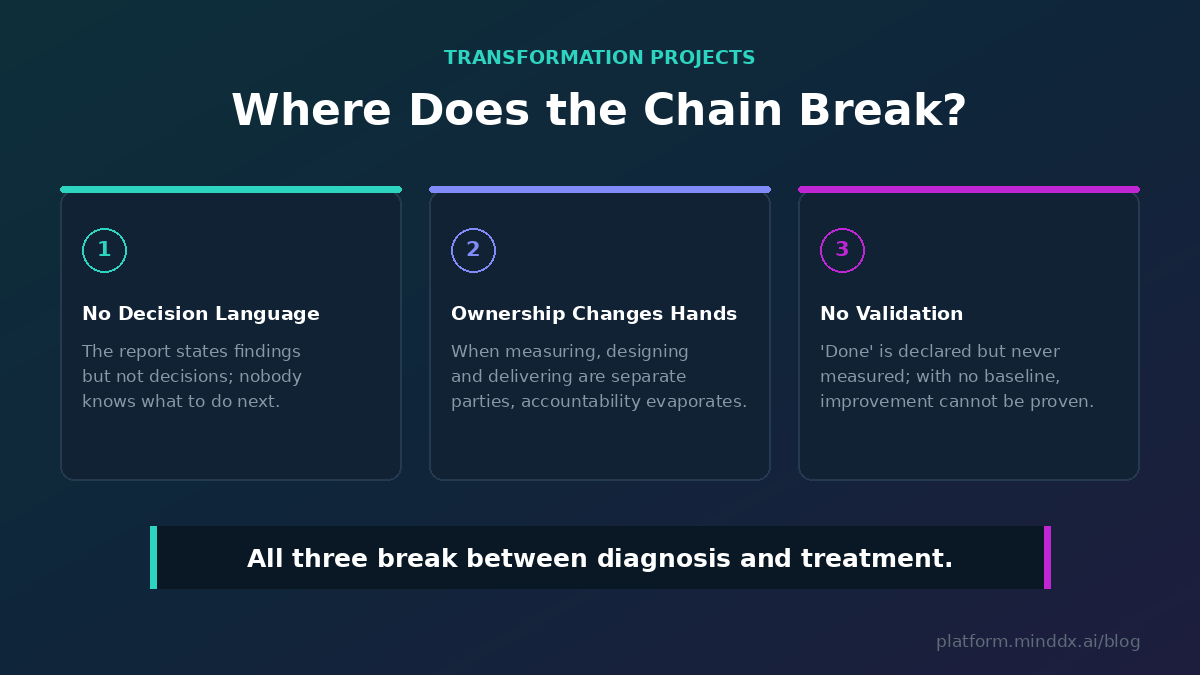
Three break points show up most often in the field, and all three operate independently of how good the report is.
First: the report was never translated into decision language. A finding and a decision are not the same thing. "Stock accuracy is low" is a finding; "the counting method changes next quarter, this person owns it, this is the success measure" is a decision. If the report delivers the first and leaves the second to the reader, the reader leaves it to the next meeting. When converting findings into decisions is nobody's job, nobody does it.
Second: ownership changes hands. In most projects the party that measures, the party that designs and the party that delivers are different. Each handover drops part of the context: why this priority was chosen, which constraint eliminated that option, what was noticed during measurement. What survives to the third pair of hands is a list with its reasoning stripped out. A list nobody can defend gets shortened at the first budget pressure.
Third: there is no validation. At project close, someone says "done." Nobody asks against what, because no baseline was recorded. An improvement without a baseline can neither be proven nor disproven; the discussion drops from measurement to opinion. That is usually why the next transformation round starts from the same place.
What the Chain Should Look Like
The medical analogy helps here, because medicine has already built this chain. An X-ray is not a result in itself; it is an input to diagnosis. A diagnosis is not a result in itself; it is an input to a treatment plan. And treatment closes with a follow-up examination — which is the input to the next assessment. No step means much on its own; its meaning comes from being connected to the next one.
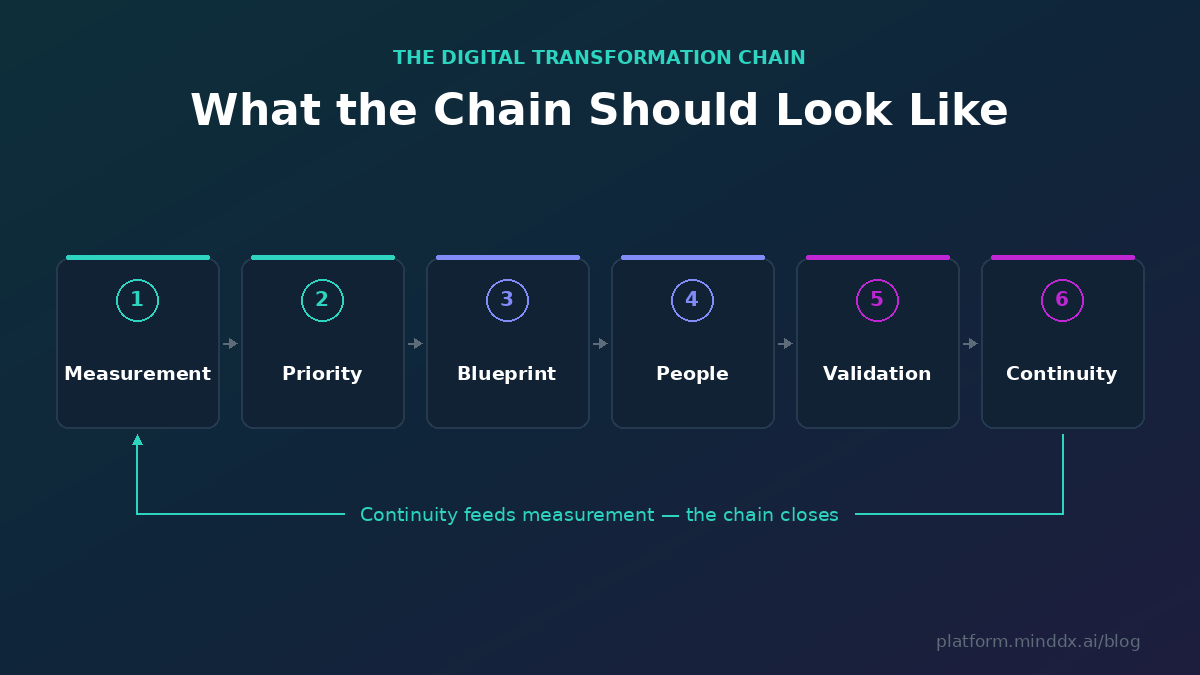
In digital transformation the same chain has six links:
- Measurement. The current state is established with evidence, not opinion. The method and its limits are stated up front; the result describes what was measured, not who measured it.
- Priority. Measurement always produces more findings than capacity. Which finding is addressed first is a commercial decision, and the reasoning is written down — because in six months that reasoning will be questioned.
- Blueprint. The chosen priorities are turned into a workable target state: how each process will run, where each piece of data comes from, who holds which decision.
- People. Can the people who will run the new process actually use it? When this link is skipped, the system goes live technically and the old method continues in practice.
- Validation. Whether the change worked is measured against the baseline. "Done" is a claim, not an observation; a claim is closed by measurement.
- Continuity. The validated state becomes the new baseline and feeds the next measurement. This is where the chain closes.
The links are not individually novel; in most organizations all six exist in some form. What is new is that the connections between them are made. If one link's output is not the next link's input, that link can work well and the chain still carries nothing.
Conclusion
Few projects can answer yes to all six questions. Did we measure? Did we prioritize, and is the reasoning written down? Did we design? Did we prepare the people? Did we validate? Did we hand it to the next round? In most projects two or three links are solid and the rest are weak — and a chain breaks at its weakest link.
The real gain here is not building all six links perfectly. The realistic gain is this: knowing in advance where the chain will break. Seeing which link is weak before the project starts makes it possible either to strengthen that link or to narrow the scope accordingly. Either beats a report sitting on a shelf six months later.
One closing note: this chain has no beginning and no end. Transformation is not a one-off project but a closing loop. Just as the follow-up examination is the start of the next assessment, every validated improvement is the baseline for the next measurement. A transformation believed to be finished has usually only stopped.
For two neighbouring topics: how a transformation journey proceeds step by step is covered in Diagnosis First: What the New Path Looks Like in Practice, and the dimension most often skipped in measurement in The Unmeasured Layer in Digital Transformation: Leadership.
This article is the sixth part of the expanding "From Man-Days to Value"
series.
1. Is This the
End of Man-Day Consulting?
2. An X-Ray of AI
Promises
3. What
AI Made Cheap in ERP, and What It Made Valuable
4. Diagnosis First: What the
New Path Looks Like in Practice
5. The
Unmeasured Layer in Digital Transformation: Leadership
6. Why Do Digital Transformation Reports Gather Dust? (this article)
Follow MindDX on LinkedIn for new analyses.